Overdentures
Learn more
The loss of many teeth or complete edentulism is not just an aesthetic problem. It also involves difficulties with chewing, poorer speech, discomfort in daily functioning, and often a decrease in self-confidence. This is why more and more patients are looking for a solution that is more stable than a classic removable denture, but at the same time less extensive and more accessible than a full fixed restoration on implants. One of the best intermediate options is the overdenture.
At Rycerska 4 Medical Center in Bytom, we look at this problem comprehensively. We combine dentistry, implantology, prosthetics, RTG diagnostics, and CBCT tomography, and if necessary, also physiotherapeutic support for the temporomandibular joints and pain therapy. As a result, the patient does not have to look for help in several places – they can undergo the entire process of diagnostics and treatment in one facility, under the care of an experienced team trusted by over 8,000 patients.
What is an overdenture?
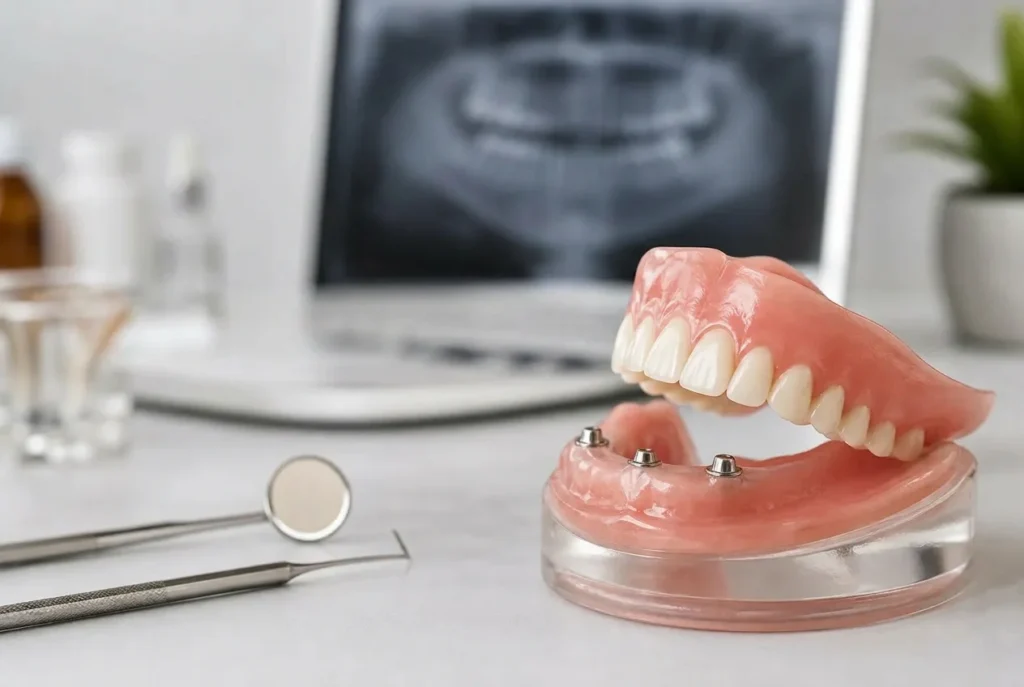
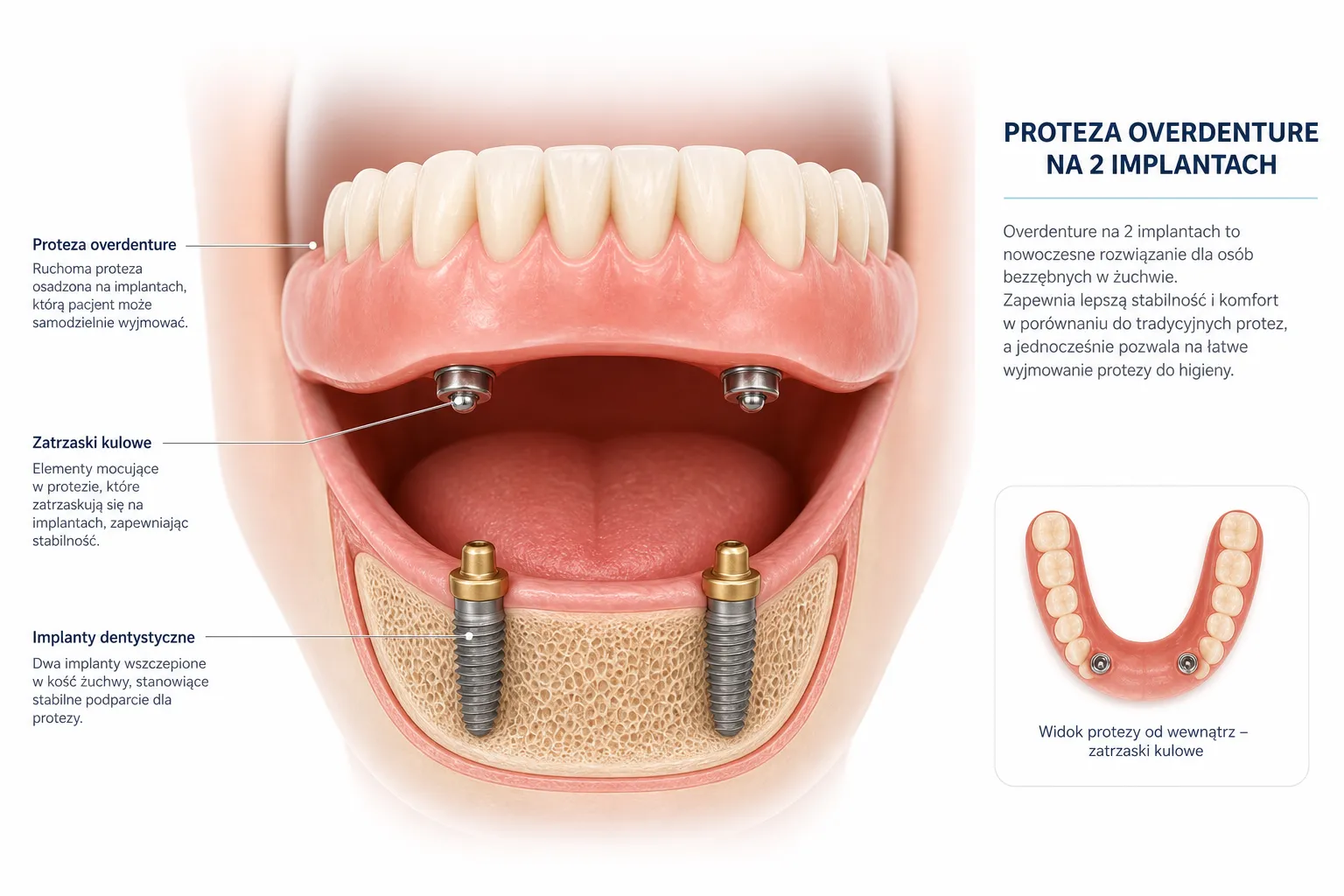
An overdenture is a removable prosthetic restoration that rests not only on the gums but is also stabilized on pillars. Such pillars can be:
- own, properly prepared teeth,
- or implants placed in the bone.
In practice, this means that the denture does not shift as easily as a classic complete denture. The patient can remove it themselves for hygiene, but once placed in the mouth, it gains significantly greater stability, comfort, and security while eating or speaking.
What distinguishes an overdenture from a regular denture?
The most important difference is the method of retention in the oral cavity. A traditional removable denture relies mainly on the mucous membrane and suction. An overdenture has additional anchorage, which is why it provides greater control over the restoration.
Key benefits for the patient
- better stability during eating and speaking,
- reduced risk of the denture shifting,
- greater psychological comfort,
- easier adaptation than with a classic denture,
- the possibility of improving facial aesthetics and lip support,
- in the implant version – more favorable transfer of chewing forces.
Who is an overdenture a good solution for?
This solution is particularly often considered by patients who:
- have complete edentulism in the maxilla or mandible,
- wear a traditional denture and complain about its mobility,
- have problems with chewing harder foods,
- want to improve their quality of life but are not always ready for a full fixed restoration,
- have residual dentition that can be used as pillars,
- are looking for an intermediate option between a classic denture and more advanced implant-supported work.
It is worth emphasizing that qualification should always be individual. The condition of the bone, gums, general health, aesthetic expectations, and budget all matter. That is why a consultation at a facility offering modern CBCT diagnostics and the care of many specialists simultaneously is so important, and Rycerska 4 Medical Center in Bytom is undoubtedly such a place.
Implant-supported overdenture or tooth-supported overdenture?
Both options are possible, but they differ in indications, the course of treatment, and long-term functionality.
Implant-supported overdenture
This solution is very often chosen by patients with edentulism. The implant serves as a stable pillar anchored in the bone. The denture can be placed on it using appropriate retention elements.
The most commonly used are:
- locator-retained denture,
- bar-supported denture,
- less frequently other retention systems.
This option is particularly valued where a classic lower denture is unstable. For many patients, even two implants in the mandible mean a huge change in quality of life.
Tooth-supported overdenture
If the patient has preserved teeth that can be used as pillars, it is possible to perform an overdenture without implantation. This is a less invasive option, but it requires the appropriate condition of the supporting teeth and their prior preparation.
Not every case is suitable for this. If the teeth are significantly damaged, loose, or the prognosis is uncertain, implant treatment may be a more predictable solution.
Locators, bars, attachments – how is the denture fixed?
This is one of the most frequently asked questions because daily comfort depends on the attachment system.
Locator-retained denture
Locator is a special retention element connecting the implant with the denture. The patient 'clicks' the denture into the mouth, achieving significantly better stability than with a classic denture.
Advantages:
- simplicity of use,
- good retention,
- relatively easy maintenance,
- often a favorable price-to-effect ratio.
Bar-supported denture
In this solution, the implants are connected by a special bar, and the denture rests on it. Such a system can provide very good stabilization, especially in more demanding anatomical conditions.
Advantages:
- very good stability,
- more even distribution of forces,
- a good solution in selected cases of advanced edentulism.
A short comparison of the systems
| Feature | Locator-retained denture | Bar-supported denture |
|---|---|---|
| Stability |
very good |
very good to excellent |
| Hygiene |
usually simpler |
may require greater precision |
| Construction | more compact |
more complex |
| Cost |
usually lower |
usually higher |
| Application | common in standard cases | common in more demanding conditions |
What does the treatment look like step-by-step?
Patients often fear that the treatment will be complicated. Meanwhile, a well-planned therapy proceeds in stages and provides predictable results.
1. Consultation and diagnostics
Initially, the doctor evaluates:
- oral conditions,
- the condition of the mucous membranes,
- bone quantity and quality,
- bite,
- patient expectations.
At Rycerska 4 Medical Center in Bytom, we use RTG and CBCT tomography, which allows us to plan the treatment very precisely and avoid guesswork.
2. Treatment plan
The patient receives a proposal for the best solution:
- overdenture on teeth,
- overdenture on 2 implants,
- overdenture on more implants,
- or alternatively, a fixed implant restoration.
At this stage, costs, the schedule, and financing options for the procedures are also discussed.
3. Site preparation
It may include:
- removal of teeth unsuitable for treatment,
- treatment of inflammation,
- hygienization,
- possible implantological preparation.
4. Implantation or preparation of abutment teeth
If the treatment is based on implants, an implantation procedure is performed. For many patients, it is important to do this in a place that operates like a modern implantology clinic, with full diagnostics and a team dealing with both surgery and prosthetics.
5. Fabrication and fitting of the prosthesis
After healing and preparation of the abutments, impressions are taken or a scan is performed, and then a custom prosthetic restoration is created.
6. Usage instructions and check-ups
The patient learns:
- how to put on and take off the prosthesis,
- how to clean it,
- when to come in for check-ups,
- how to care for the implant and the tissues around it.
Is an overdenture prosthesis comfortable?
In most cases – definitely yes, especially when compared to a loose complete denture. However, three elements are key:
- proper qualification,
- precise execution,
- regular check-ups.
Not every prosthesis will be perfect "from day one." Sometimes an adaptation period, minor adjustments, and learning a new way of biting are necessary. A well-guided patient goes through this stage much more easily.
Does an overdenture prosthesis have a palate?
This depends on the type of restoration, anatomical conditions, and the treatment plan. In many cases – especially in the lower arch – the issue of the palate does not occur at all. In the maxilla, it is often possible to design a prosthesis that is more comfortable than a classic complete denture, but the decision depends on stability and safety of use.
This is a significant advantage of overdenture over traditional solutions: in some patients, taste perception, speech comfort, and daily functioning can be improved.
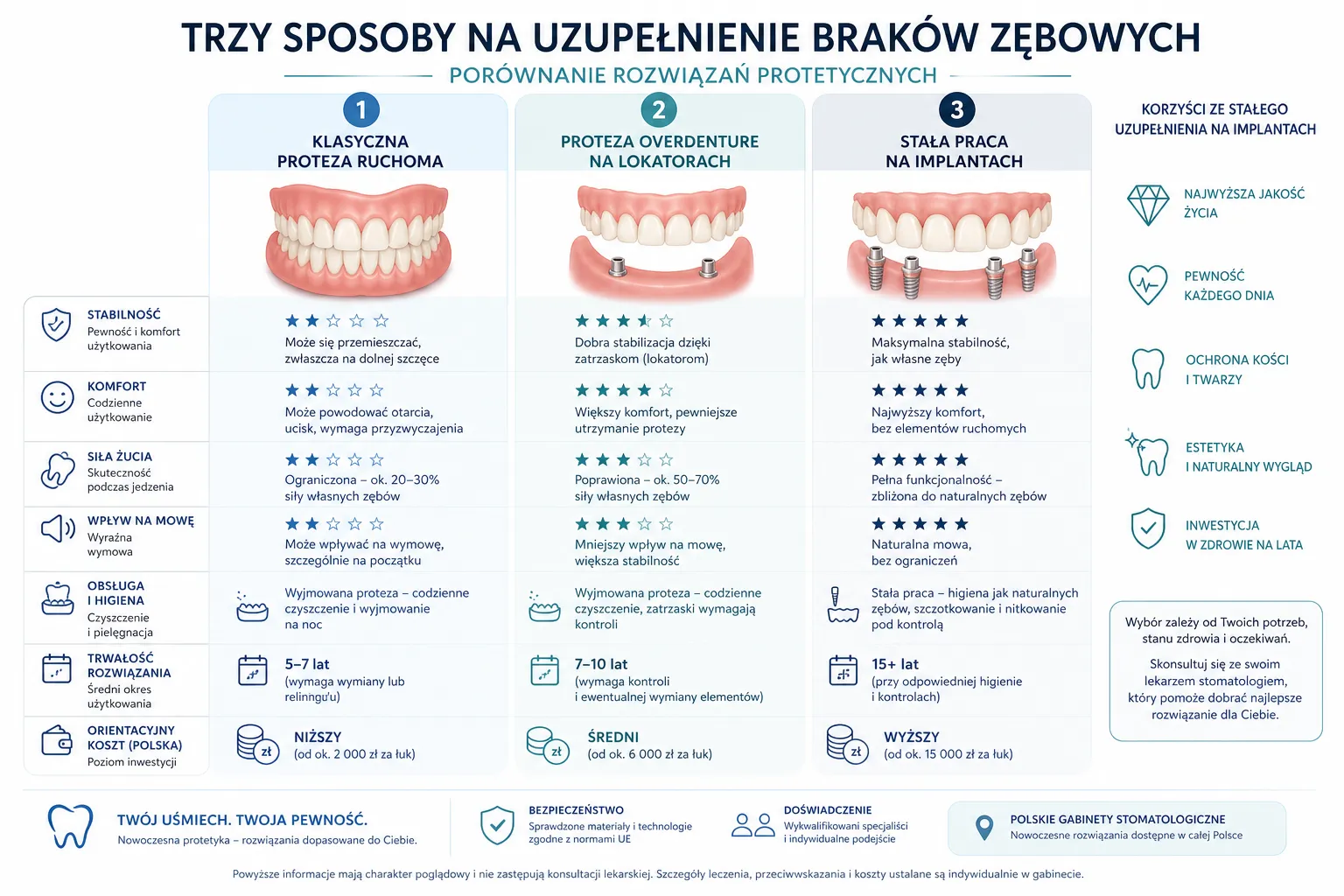
Overdenture vs. a fixed restoration on implants – what to choose?
This is not a question of a "better" solution for everyone, but about a better solution for a specific patient.
Comparison of the most important options
| Solution | Stability | Removability | Comfort | Cost | For whom |
|---|---|---|---|---|---|
| Classic removable prosthesis | low to moderate | yes | moderate | lowest | when a basic solution is needed |
| Implant-supported overdenture | high | yes | high | medium | for patients seeking stability without fixed work |
| Fixed implant restoration | very high | not by the patient | very high | highest | for people expecting maximum function and a fixed restoration |
Not every patient immediately needs a full fixed restoration. For many, an overdenture is the most reasonable compromise between price, comfort, and predictability of the outcome.
What are the greatest advantages of an overdenture?
- Greater stability – the biggest advantage compared to classic removable prostheses.
- Better quality of life – the patient usually feels improvement while eating, speaking, and smiling.
- Easier hygiene – the prosthesis can be removed and thoroughly cleaned.
- A more economical solution than a fixed restoration – this is important for patients who want to improve comfort but are rationally planning their budget.
- The possibility of treatment in one place – at Rycerska 4 Medical Center in Bytom the patient can undergo consultation, diagnostics, implantological and prosthetic treatment, and follow-up care without having to move between facilities.
What should be kept in mind before making a decision?
An overdenture prosthesis is not a "universal" solution. Before starting treatment, it is worth knowing that:
- regular follow-up visits are necessary,
- retention elements may require replacement over time,
- hygiene is of great importance for the durability of the work,
- with an implant-supported prosthesis, the condition of the bone and gums is essential,
- sometimes additional preparatory procedures are needed.
Therefore, the best results are achieved where the treatment plan is created by a team, not a single person operating in only one area.
How to care for an overdenture prosthesis?
Daily care has a direct impact on the comfort and durability of the treatment.
Key principles
- clean the prosthesis daily according to the doctor's instructions,
- take care of the hygiene of the gums, tongue, and oral cavity,
- if the prosthesis is implant-supported, also clean the areas around the retention elements,
- do not skip follow-up visits,
- react if pressure, pain, or a decline in stability occurs.
In some cases, dental physiotherapy can also be helpful, especially if the patient has compensated for missing teeth for years through incorrect muscle function, clenching, or overloading the temporomandibular joints.
Rycerska 4 Medical Center in Bytom – why is it worth it?
Choosing a prosthesis is not just about choosing the product itself. It is about choosing a place where someone will truly guide the patient through the entire process.
What do you gain with us?
- comprehensive care across multiple specialties in one facility,
- experienced team of doctors and therapists,
- modern RTG diagnostics and CBCT tomography,
- a wide range of services: from dentistry and implantology to physiotherapy, pain therapy, and aesthetic medicine,
- convenient online registration, contact via phone and WhatsApp,
- location in the center of Bytom,
- the option to purchase treatment vouchers,
- support in financing treatments.
For the patient, this means less stress, better treatment coordination, and a greater sense of security.
When to schedule a consultation?
It is not worth waiting until a loose prosthesis starts to make eating difficult, cause abrasions, or lead to social withdrawal. If:
- your current prosthesis irritates you,
- you are afraid it will fall out while speaking,
- you avoid harder foods,
- you want to regain comfort and self-confidence,
this is a good time to talk about overdentures and check if this solution is right for you.
Summary
An overdenture is a modern, comfortable, and very practical solution for people with significant tooth loss or complete edentulism. It provides more stability than a traditional removable denture while remaining a less extensive and often more accessible solution than a full fixed restoration on implants.
If you want to find out whether a locator-retained denture, bar-retained denture, or another form of implant-prosthetic treatment is better in your case, schedule a consultation at the Rycerska 4 Medical Center in Bytom. In one facility, in the center of Bytom, you will receive diagnostics, a treatment plan, and care from an experienced team – with concern for health, comfort, and aesthetics.
Rycerska 4 Medical Center in Bytom is a modern facility trusted by over 8,000 patients, offering a wide range of services, an experienced team of doctors and therapists, convenient online registration, telephone contact and via WhatsApp, as well as support in treatment financing and the possibility of purchasing gift vouchers for treatments at the clinic.
Explore the details of our offer in the following areas:
- comprehensive conservative dentistry
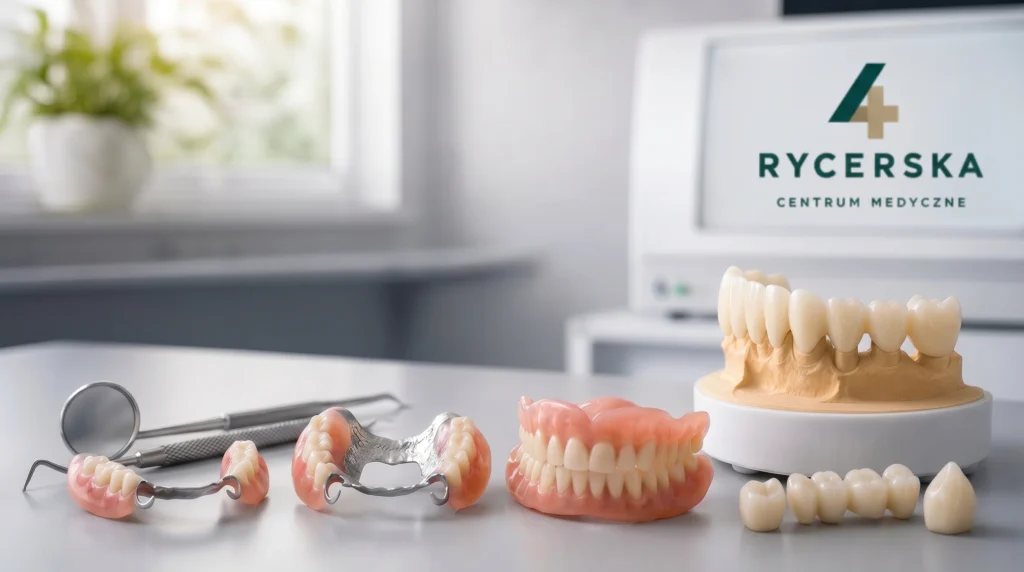
- comprehensive dental prosthetics
- dental surgery
- modern implantology
- comprehensive treatment under a microscope
- endodontics
- comprehensive dental prophylaxis
- professional hygienization
- comprehensive RTG and CBCT (tomography) diagnostics
- dental physiotherapy
- aesthetic medicine
- aesthetic facial physiotherapy
- general physiotherapy, pain therapy
- massages
| Procedure name | Price |
|---|---|
| Prosthetic consultation | 200 zł |
| Follow-up examination after prosthetic treatment | 150 zł |
| Whitening tray | 300 PLN |
| Relaxation splint | 500 zł |
| Acrylic micro-denture (1 – 2 teeth) | 600 zł |
| Partial acrylic denture | 1,000 zł |
| Full acrylic denture | 1,200 zł |
| Express denture fabrication | + 50% of the service value |
| Skeletal denture | 1,800 zł |
| Flexible denture | 1,800 zł |
| Splint-denture | 2,000 PLN |
| Precision attachment – slide, attachment (per piece) | 600 zł |
| Skeletal denture with precision attachments | 2,400 PLN |
| Immediate denture | 1,250 PLN |
| Denture repair without impression | 300 PLN |
| Denture repair with impression | 350 PLN |
| Flexible denture repair | 500 zł |
| Addition of a tooth to a denture | 350 PLN |
| Addition of another element (tooth, clasp) | 100 PLN |
| Denture relining | 500 zł |
| Denture reinforcement | 300 PLN |
| Cast metal post and core | 500 zł |
| Temporary crown | 150 zł |
| Temporary bridge | 300–400 PLN |
| Temporary acrylic bridge (per unit) | 250 PLN |
| Adhesive bridge on composite fiber | 550–650 PLN |
| Porcelain-fused-to-metal crown | 1,300 PLN |
| Bridge unit (porcelain-fused-to-metal) | 1,300 PLN |
| Porcelain crown on zirconia | 1,800 zł |
| Bridge unit (porcelain on zirconia) | 1,800 zł |
| Gingival porcelain (per unit) | 250 PLN |
| Bridge rest | 250 PLN |
| Porcelain veneer | 2,000 PLN |
| Composite veneer | 500–700 PLN |
| Cementing of a restoration from another clinic | 250 PLN |
| Sectioning of an old bridge or crown | 100–400 PLN |
| Procedure name | Price |
|---|---|
| Screw-retained crown on implant, full-contour zirconia (1 unit) | 2,500 - 3,000 PLN |
| Temporary crown on implant (1 unit) | 1,500 PLN |
| Full denture on a bar on two implants | from 8,000 PLN |
| Full denture on a bar on four implants | from 12,000 PLN |
| Overdenture on locators (depending on extent) | from 6,000 PLN |
| All-on-X full-arch prosthesis | individual quote |

See reviews
Looking for an ideafor a gift?


Select voucher type

Complete the details and pay for the order

Collect the voucher online or on-site