Removable dentures
Learn more
Tooth loss affects not only the aesthetics of the smile but also daily comfort: chewing, clear speech, self-confidence, and even the condition of the temporomandibular joints. For many patients, the best first step in smile reconstruction is removable prosthetic restorations – modern, functional, and individually tailored to the oral cavity conditions.
If you are looking for a place where a prosthodontic clinic collaborates with diagnostics, implantology, dental hygiene, and dental physiotherapy, at Rycerska 4 Medical Center in the center of Bytom, the patient can undergo the entire treatment journey in one facility – from consultation and RTG to the restoration fabrication and follow-up visits.
What are removable prosthetic restorations?
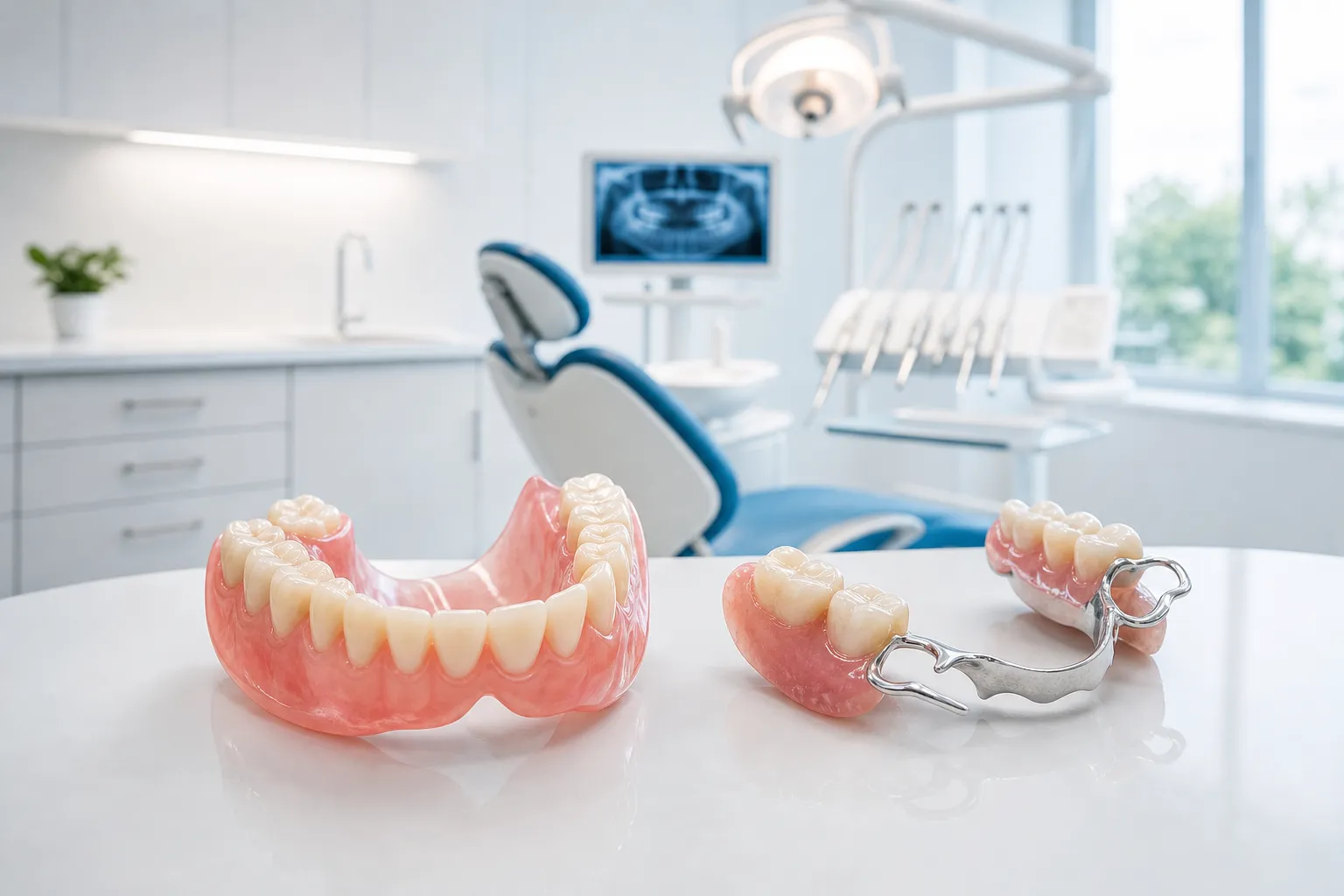
Removable prosthetic restorations are dental prostheses that the patient can independently remove and reinsert. They are used for partial or complete tooth loss when it is necessary to restore chewing function, aesthetics, and support for soft tissues.
Their great advantage is that they can be adapted to various anatomical conditions and budget requirements. In practice, they are often a solution:
- temporary before implant treatment,
- permanent for extensive tooth loss,
- an alternative when implants or bridges are currently not possible,
- support for patients after extractions and during bite reconstruction.
Why is restoring missing teeth so important?
Unrestored missing teeth are not just an aesthetic issue. Over time, they lead to overloading of the remaining teeth, malocclusion, difficulty chewing food, and impaired speech. Patients also frequently report psychological discomfort and a decline in self-confidence.
That is why properly selected prosthetics should be viewed not as an "aesthetic addition," but as a vital component of dental treatment and rehabilitation.
Important:
the success of prosthetic treatment is guaranteed only if the full treatment plan is completed; specifically, the full restoration of both dental arches is required (completeness condition). Performing an incomplete restoration often exacerbates existing problems.
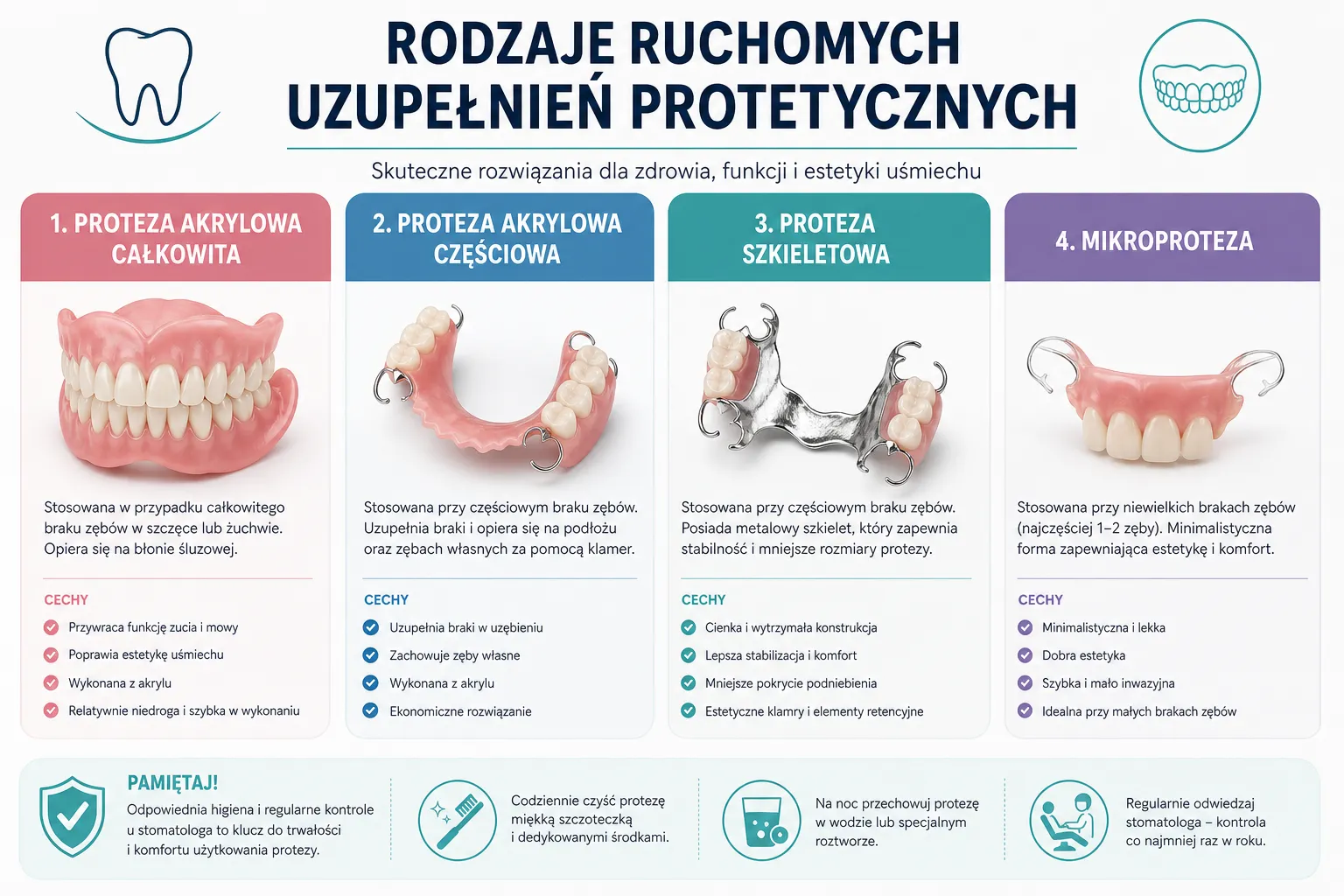
Types of removable prosthetic restorations
In clinical practice, the choice of a specific variant depends on the number of missing teeth, gum condition, remaining teeth, bite, aesthetic expectations, and the long-term plan.
Full acrylic denture
This solution is used for complete tooth loss in the maxilla, mandible, or both arches. Such an acrylic denture restores the full dentition and helps improve facial appearance, speech, and chewing function.
Advantages:
- relatively affordable,
- allows for rapid restoration of extensive tooth loss,
- improves aesthetics and support for lips and cheeks.
Limitations:
- requires an adaptation period,
- it may be less stable than implant-based solutions,
- in the upper arch, it often covers the palate, which some patients find interferes with taste perception or wearing comfort.
Partial acrylic denture
Used when the patient has retained some of their own teeth. It restores single or multiple missing teeth and is supported by both the mucous membrane and the remaining teeth.
Advantages:
- a good option for a larger number of missing teeth,
- can be performed relatively quickly,
- sometimes serves as a transitional solution before further treatment.
What you should know:
- is usually less comfortable than a skeletal prosthesis,
- can have larger dimensions,
- requires meticulous hygiene of both the prosthesis itself and the abutment teeth.
Skeletal denture
Skeletal prosthesis is a more advanced restoration for partial tooth loss. Its construction features a metal framework, making it thinner, more stable, and better at transferring chewing forces.
Why do many patients rate it higher than a partial acrylic denture?
- stays better in the oral cavity,
- is usually more comfortable,
- has a smaller coverage area,
- chewing loads are more physiologically distributed.
This solution is particularly worth considering for patients who want to combine durability with higher comfort of use.
Micro-prosthesis
Micro-prosthesis can be used for minor tooth loss, especially when a small, discreet restoration is desired. This solution may not be suitable for everyone, but in certain cases, it provides an aesthetic and quick form of reconstruction.
It is worth remembering that the suitability of a micro-prosthesis depends not only on the number of missing teeth but also on their location, bite conditions, and the health of adjacent teeth.
Overdenture
An overdenture is a very important option for patients seeking greater stabilization. Such a prosthesis is supported by implants or preserved tooth roots.
Key benefits:
- better retention,
- greater comfort during eating and speaking,
- less movement of the prosthesis,
- a better sense of security on a daily basis.
For some patients, this is an excellent transitional stage between a classic denture and full implant-prosthetic reconstruction.
Removable or fixed? Key differences
Many patients search for terms related to dentures because they are unsure whether to choose a removable solution, a bridge, or an implant. The following comparison helps clarify the options.
| Feature | Removable restorations | Fixed restorations |
|---|---|---|
| Method of use | Can be removed independently | Remain permanently in the oral cavity |
| Comfort | Depends on the type of prosthesis and adaptation | Usually higher |
| Stabilization | Good to very good, depending on the solution | Usually very good |
| Hygiene | Requires removal and cleaning outside the oral cavity | Requires thorough hygiene, just like natural teeth |
| Initial cost | Often lower | Often higher |
| Application | In cases of partial and total tooth loss | Under appropriate dental or implant conditions |
At Rycerska 4 Medical Center, the selection of the method is not based on a single template. Thanks to modern RTG diagnostics and CBCT tomography, it is possible to assess bone conditions and the state of abutment teeth to plan treatment sensibly – both for today and for the future.
When is a removable denture a good choice?
A removable prosthetic restoration should be considered when:
- tooth loss is extensive,
- the patient currently does not qualify for implants,
- a quick dental restoration is necessary,
- a transitional solution is needed before permanent treatment,
- financial considerations are important,
- the general or local condition requires staged treatment.
This is important because good prosthetics is not about choosing the "trendiest" option, but about matching the solution to the patient's real needs.
What does the prosthesis manufacturing process look like?
This is another area that is described too generally in many texts. Meanwhile, the course of treatment is often most important for the patient.
1. Consultation and diagnostics
The first stage is a thorough examination of the oral cavity, assessment of missing teeth, the condition of the gums, bite, and temporomandibular joints. If necessary, imaging diagnostics are performed – RTG or CBCT.
2. Preparation of the oral cavity
Before making the prosthesis, it is necessary to treat inflammations, caries, sometimes remove teeth with a poor prognosis, or perform hygiene treatments. This is a condition for the durability and safety of the treatment.
3. Taking impressions or scans
On this basis, an individual restoration design is prepared.
4. Fitting and adjustment
During the fitting stage, the doctor assesses the tooth alignment, vertical dimension of occlusion, smile aesthetics, and comfort.
5. Delivery of the prosthesis and instructions
The patient receives the finished prosthesis and detailed instructions on use, hygiene, and adaptation.
6. Adjustments and follow-up visits
This is not an addition, but a part of the treatment. Even a well-made prosthesis may require adjustments to pressure points or subsequent relining.
How long does it take to get used to the prosthesis?
Adaptation is individual. In some patients it takes a few days, in others several weeks. At the beginning, the following may occur:
- foreign body sensation,
- increased salivation,
- minor speech difficulties,
- discomfort when biting harder foods,
- local abrasions.
This is usually a natural stage. However, the key is not to "wait out" the pain for many weeks. If the prosthesis presses, causes sores, or clearly shifts, a check-up is needed.
Recommendations for the use of a removable prosthesis
This is the most important part for the patient, and at the same time, a topic often treated too briefly by the competition. Below are practical rules that actually affect the comfort and durability of the treatment.
How to eat in the first few days?
At the beginning, it is best to choose foods that are:
- soft,
- lukewarm,
- easy to chew,
- cut into small pieces.
It is worth chewing bilaterally to distribute the pressure evenly. It is better to avoid very hard, sticky, and chewy foods.
How to speak more clearly?
A good exercise is reading aloud for a few minutes a day. This helps the tongue and cheek muscles get used to the new situation in the oral cavity faster.
Should the prosthesis also be worn at night?
This depends on the doctor's recommendations. In many cases, at the beginning, the patient may receive individual instructions on temporary wearing of the prosthesis also for longer periods during the day, but ultimately the mucous membrane should usually have time to rest. The final recommendation always depends on the type of prosthesis and clinical conditions.
How to clean the prosthesis?
The prosthesis should be cleaned codziennie, gently and systematically.
The most important rules:
- wash the prosthesis after meals or at least in the morning and evening,
- use preparations designed for prostheses or a soft-bristled brush,
- do not clean the prosthesis with aggressive agents or boiling water,
- also clean the tongue, gums, and palate,
- do not forget about your remaining natural teeth.
The combination of chemical and mechanical methods is significantly more effective in removing biofilm from prosthesis surfaces than using only one method.
Where to store the prosthesis?
The storage method depends on the material and the doctor's recommendations. Not every prosthesis should be left "dry," and not every one requires constant immersion in liquid. Therefore, it is worth following the instructions provided after the delivery of the prosthesis.
What not to do?
You should not:
- file down the prosthesis yourself,
- use random adhesives or home repair methods,
- postpone visits when abrasions occur,
- ignore a wobbling prosthesis,
- skip follow-ups just because it is "bearable."
How to care for gums and the oral cavity with a prosthesis?
A prosthesis is only part of the treatment. The tissues beneath it also require care. Gentle gum massage, mucosal hygiene, and regular check-ups help reduce the risk of inflammation, fungal infections, and painful pressure sores.
For patients with muscle tension, occlusal problems, or overloading, dental physiotherapy can also be helpful. This is a significant advantage of facilities such as Rycerska 4 Medical Center, where a patient can benefit not only from prosthetics but also from pain therapy, facial physiotherapy, and the support of specialists working as a team.
When to seek an urgent follow-up?
Schedule an appointment as soon as possible if the following occur:
- pain lasting longer than a few days,
- ulcers or small wounds,
- prosthesis movement,
- cracking or damage to the restoration,
- difficulty eating despite the adaptation period,
- unpleasant odor or symptoms of inflammation.
Well-fitted prostheses Bytom are not just a matter of fabrication, but also follow-ups and potential adjustments during use.
Is a prosthesis always the final solution?
No. For many patients, a removable prosthesis is an excellent solution at a given stage of life, but it sometimes also serves as part of a larger treatment plan. After improving the oral conditions, one can consider:
- an implant-supported prosthesis,
- bridges,
- crowns,
- full implant-prosthetic treatment.
This is precisely why a facility that looks at the patient more broadly than through the lens of a single procedure is so important. At Rycerska 4 Medical Center, treatment based on comprehensiveness has been developed for many years – from dentistry and implantology to modern diagnostics, hygiene procedures, aesthetic medicine, and physiotherapy.
How much do removable prosthetic restorations cost?
There is no single universal price, as the cost depends on many factors:
- type of prosthesis,
- the number of missing teeth,
- material,
- the complexity of the case,
- the need for prior treatment,
- potential adjustments and intermediate stages.
If a patient is interested in protetyka na raty, worth asking about available forms of financing treatment. This solution allows you to spread the costs of a more advanced reconstruction over time and start therapy faster instead of putting it off until later.
How to choose a good facility for prosthetic treatment?
When choosing a place, it is worth paying attention not only to the price list but primarily to the overall standard of care. An equally inappropriate criterion for evaluating a facility is the completion date of the prosthesis – it must be remembered that we make a prosthesis for a long period, and the time spent on its fabrication and subsequent fitting will pay off in the future with greater comfort of use.
A good facility should offer:
- a thorough consultation and treatment plan,
- on-site imaging diagnostics,
- the possibility of cooperation between several specialists,
- follow-up care after the prosthesis is fitted,
- clear recommendations and patient education,
- solutions tailored to your budget and expectations.
At Rycerska 4 Medical Center, patients from Bytom and the surrounding areas value this very consistency: many specializations in one facility, an experienced team of doctors and therapists, modern RTG and CBCT diagnostics, convenient online registration, and contact via phone and WhatsApp. The trust of over 8,000 patients is not built by chance – it is the result of a consistent approach to the quality of treatment and service comfort.
Removable prosthetic restorations and quality of life
A well-designed prosthesis can realistically improve daily functioning. Patients return to a natural smile faster, eat more easily, speak more clearly, and regain a sense of control over their appearance. To achieve full comfort in using the prosthesis, full cooperation between the Patient and the doctor is necessary , which includes reporting any concerns as they arise and utilizing free adjustments, which are a normal stage in the dental rehabilitation process.
If, additionally, the treatment is carried out in stages, including hygiene procedures, diagnostics, and further restoration options, the patient gains not only a prosthesis but a complete plan for improving oral health and rehabilitation.
Summary
Removable prosthetic restorations are a proven and still very important solution in modern dentistry. They can be used as both definitive treatment and a transitional stage before more advanced restoration. However, the key to success is not only the fabrication of the prosthesis itself but also the completeness of the restoration, proper fit, hygiene, check-ups, and individual recommendations.
If you are interested in dental prostheses tailored to your needs, are looking for a safe place for comprehensive treatment, or want to check whether an acrylic prosthesis, a skeletal prosthesis, a micro-prosthesis, or an implant solution would be better, schedule a consultation at Rycerska 4 Medical Center. In one facility, in the center of Bytom, you will receive diagnostics, a treatment plan, support from multiple specialists, convenient registration, and financing options for procedures. This is care that truly leads the patient from problem to solution.
Rycerska 4 Medical Center in Bytom is a modern facility trusted by over 8,000 patients, offering a wide range of services, an experienced team of doctors and therapists, convenient online registration, telephone contact and via WhatsApp, as well as support in treatment financing and the possibility of purchasing gift vouchers for treatments at the clinic.
Explore the details of our offer in the following areas:
- comprehensive conservative dentistry
- comprehensive dental prosthetics
- dental surgery
- modern implantology
- comprehensive treatment under a microscope
- endodontics
- comprehensive dental prophylaxis
- professional hygienization
- comprehensive RTG and CBCT (tomography) diagnostics
- dental physiotherapy
- aesthetic medicine
- aesthetic facial physiotherapy
- general physiotherapy, pain therapy
- massages
| Procedure name | Price |
|---|---|
| Prosthetic consultation | 200 zł |
| Follow-up examination after prosthetic treatment | 150 zł |
| Whitening tray | 300 PLN |
| Relaxation splint | 500 zł |
| Acrylic micro-denture (1 – 2 teeth) | 600 zł |
| Partial acrylic denture | 1,000 zł |
| Full acrylic denture | 1,200 zł |
| Express denture fabrication | + 50% of the service value |
| Skeletal denture | 1,800 zł |
| Flexible denture | 1,800 zł |
| Splint-denture | 2,000 PLN |
| Precision attachment – slide, attachment (per piece) | 600 zł |
| Skeletal denture with precision attachments | 2,400 PLN |
| Immediate denture | 1,250 PLN |
| Denture repair without impression | 300 PLN |
| Denture repair with impression | 350 PLN |
| Flexible denture repair | 500 zł |
| Addition of a tooth to a denture | 350 PLN |
| Addition of another element (tooth, clasp) | 100 PLN |
| Denture relining | 500 zł |
| Denture reinforcement | 300 PLN |
| Cast metal post and core | 500 zł |
| Temporary crown | 150 zł |
| Temporary bridge | 300–400 PLN |
| Temporary acrylic bridge (per unit) | 250 PLN |
| Adhesive bridge on composite fiber | 550–650 PLN |
| Porcelain-fused-to-metal crown | 1,300 PLN |
| Bridge unit (porcelain-fused-to-metal) | 1,300 PLN |
| Porcelain crown on zirconia | 1,800 zł |
| Bridge unit (porcelain on zirconia) | 1,800 zł |
| Gingival porcelain (per unit) | 250 PLN |
| Bridge rest | 250 PLN |
| Porcelain veneer | 2,000 PLN |
| Composite veneer | 500–700 PLN |
| Cementing of a restoration from another clinic | 250 PLN |
| Sectioning of an old bridge or crown | 100–400 PLN |
| Procedure name | Price |
|---|---|
| Screw-retained crown on implant, full-contour zirconia (1 unit) | 2,500 - 3,000 PLN |
| Temporary crown on implant (1 unit) | 1,500 PLN |
| Full denture on a bar on two implants | from 8,000 PLN |
| Full denture on a bar on four implants | from 12,000 PLN |
| Overdenture on locators (depending on extent) | from 6,000 PLN |
| All-on-X full-arch prosthesis | individual quote |

See reviews
Looking for an ideafor a gift?


Select voucher type

Complete the details and pay for the order

Collect the voucher online or on-site